http://clustrmaps.com/en/admin/action.php?action=complete%20registration&id=67564&code=d8OjeUBl

tirsdag 22. april 2014

New solar panels?


Scientists at NTNU (Norwegian University of Science and Technology) are working with a new type of solar panel which is more efficient and cheaper to produce. They are working with an algae type called diatom, and they are trying to copy the amazing ability to absorb sunlight which it has developed during millions of years of evolution. The shell of the diatom is made of glass. It has small pores and symmetrical, but complicated patterns where the sunlight enters without it being able to leave. The scientists say “This is exactly how a god solar panel should behave”.
 
We decided to take a walk around in Sandvika, the city were we go to school, to see if we could find places suitable for solar-panels. We found several places were one could have used the space more efficiently. We brought with us our mobile phones and took some awesome pictures of where we think the space could have been used more efficiently.


These are pictures of a parking lot on the top level of Sandvika Mall. Often, this parking lot is less used than the indoor parking lots bellow. Therefore we think that it is a good idea to build a roof here where there should be solar panels on top. It is the perfect places for solar panels because there is nothing that will cast a shadow on to the roof, and therefore the sun will shine with maximum effect here.
 
¨
This is a perfect place for solar panels

 
This i our school, it would look good with solar panels
 
 
All of this roof could be solar panels!
 
There are many opportunities!
 
 
This post was written as collaboration post with my fellow student Jørgen. Links to his blog:


tirsdag 8. april 2014

Why I agree with Snowden’s actions


Edward Snowden is a former National Security Agency subcontractor who disclosed thousands of classified documents to American media. He is now being pursued by the American government charged with espionage, and he is currently in Russia where he has been granted a one-year temporary renewable asylum. Snowden once said “My sole motive is to inform the public as to that which is done in their name and that which is done against them.

Whether if it was right or wrong what Snowden did is a difficult question. Personally I agree with Edward Snowden’s actions. It is scary to think that the government can trace individuals and read all their personal emails and see everything they do online. Snowden is not a traitor in my eyes, and he should not be charged with espionage. As he said himself, he has not given the information to any other country, but to the American public. He had the opportunity to share confidential information, and he believed that his actions would help America. He helped the Americans see what their own government was doing, and maybe still does. In my opinion, it is people like Snowden that prevent the government from doing as they please.

tirsdag 1. april 2014

April Fools’ Day


April Fools’ Day is an informal holiday celebrated every year on April 1. People from all around the world play pranks on each other, and the holiday has been celebrated since the Roman times. There are many different theories on the origin of April Fools’ Day, but the most common explanation is that it began as a way to mock French people who were slow to switch from the old Julian calendar to the Gregorian calendar which changed New Year's from April 1 to January 1. One problem with this explanation is that it does not account for the spread of April Fools' Day to the rest of the world. The British did not adapt the Gregorian calendar until 1752, but they had already been celebrating April Fools’ Day for a while. The origin remain a mystery, but that does not stop people from pranking each otherJ  

tirsdag 18. mars 2014

Alaska WW2 project


We have been working with some students in Alaska on a project we have been calling “Alaska WW2 project”. My group chose wrote a text about Norway during the World War II, Milorg a Norwegian resistance group and “The Norwegian heavy water sabotage”. We chose this because we wanted the students from Alaska to learn a bit about the war from the Norwegian point of view. They seemed very interested in our opinions on the war, and they had some questions that we answered. We also asked them about their opinions on the war, and if they knew anybody involved in the war. It was a fun project, and the highlight was when we made the video introducing ourselves, and then receiving a video where they did the same.

mandag 17. mars 2014

Desalination


“Water will become more valuable than oil”
“The wars of 21st century will be fought over water”
“By 2025 half of the world the world would not have access to adequate water”

These are some sayings and predictions made by people around the world. The world is running out of clean water. It is as simple as that. Over the last centuries, the world has been using more clean water than it can create. It is the same as if you are emptying a bathtub more than you are filling it, eventually the bathtub will become empty. Many people see desalination as the solution on the water crisis. Desalination refers to a process where salt and other minerals are removed from saline water. And with all the salt water available in the oceans, why is this not a reality?
 

First of all, the desalination process needs a lot of energy, which makes it more expensive than the other possibilities such as collecting fresh water from rivers or groundwater, water recycling or water conservation. These other options are not as sustainable, but they are a lot cheaper and without some of the other challenges that come with desalination, such as the pollution. All the left over salt after the desalination becomes concentrated waste stream called brine, which contains up to twice as much salt as regular salt water. The brine does also often contain chemicals such as chlorine and other nature damaging substances.  A few years back, around 5 to 10 kWh were needed  to create one cubic meter of clean water, and even with the technology we have today, it needs around 2kWh. The technology has improved, and the cost has gone down, but it is still not compete able with the other options.
 
Even though there are some challenges considering desalination, there are also some advantages, for example the guarantee of clean water in the event of drought. As stated earlier in this post, there is no lack of water from the ocean. Since there are so much water in the ocean, taking the water from there will not affect the habitat of the fishes or animals the way it does when the water is taken from a smaller lake or smaller rivers. Another advantage is that one of the big desalinisation plants can supply up to 500 million litres of fresh water each day.
 
In my opinion, desalination can be the solution of the water crisis, but only if the technology in the desalination field improves. The need of energy to make clean water has decreased, but there are still the environmental issues that have to be taken care of.  There is a long way to go until we solve the water problems, but making desalination a cheap and safe way to get clean water would be a giant leap towards the goal.
 
Sources:
http://everylittledrop.com.au/is-desalination-the-answer-to-global-water-shortages

Picture: http://en.wikipedia.org/wiki/Desalination 

søndag 16. mars 2014

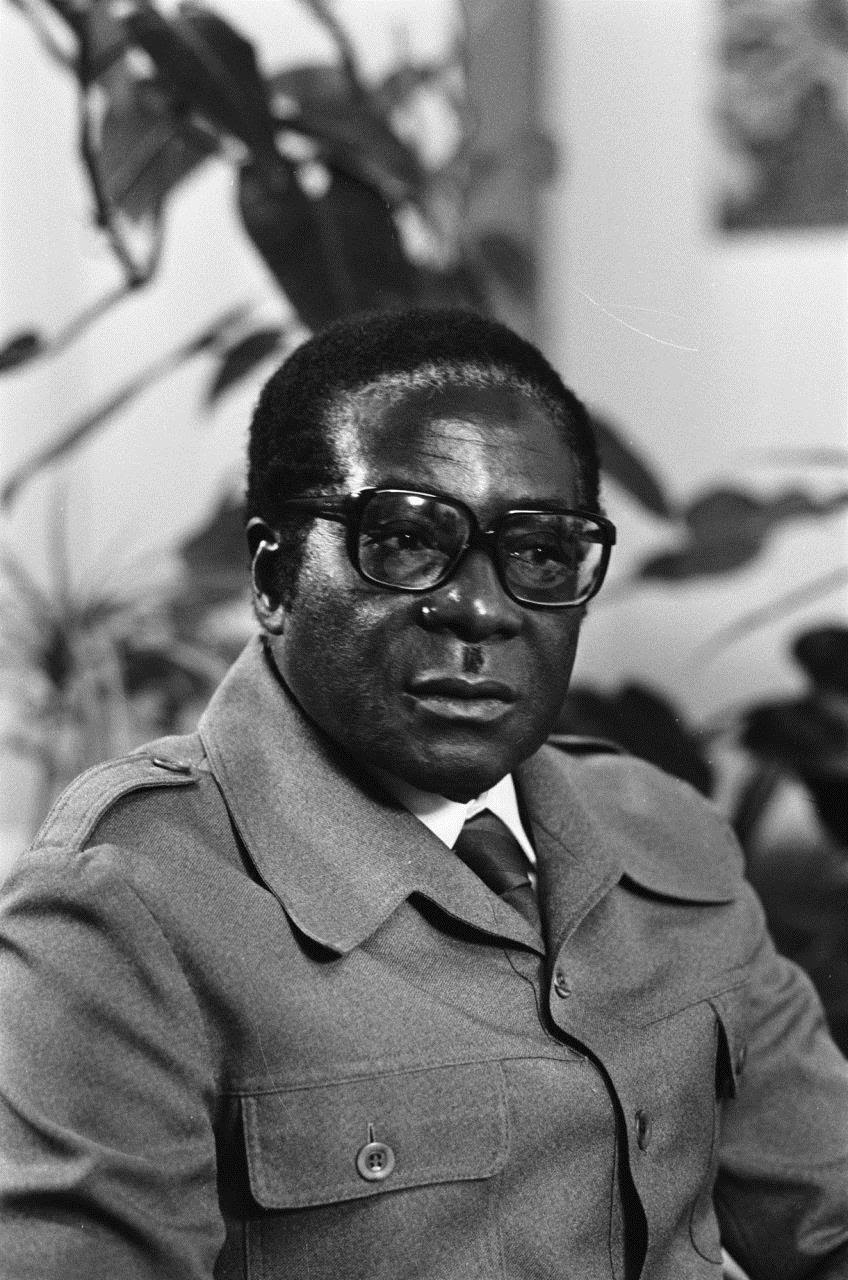
Rober Mugbe's road to presidency


Our teacher was at a teacher seminar this week so we had a substitute teacher who was born in Zimbabwe. We talked about the history of Zimbabwe and the current situation there. An important person for the development of Zimbabwe over the last decades is the president of Zimbabwe Robert Mugabe.  Because of his importance, I wanted to find out more about him before he became the president of Zimbabwe.  
Robert Mugabe was born February 21, 1924 in Kutama, Zimbabwe, or Southern Rhodesia as it was known back then.  He was born just months after his area had become an English colony, and several new laws caused limitations to education and job opportunities in his village. Although it was unusual in his village, Mugabe was fortunate enough to receive a good education. A powerful influence on Mugabe was one of his teachers at the local Jesuit mission school, who taught him that all people should be treated equally and educated the local Jesuit mission. Mugabe moved on to become teacher himself, and he taught at several mission schools whilst studying on his own.

After teaching and studying for a while, he returned to his hometown with Bachelor degrees in education, art and science, and also his fiancée that he meet whilst studying in Northern Rhodesia. He then experienced that tens of thousands of black families had been displaced by the new colonial government and that the white population had increased massively. The new government was suppressing the black population, and this lead to violent protests. Mugabe was outraged, and in 1960 he attended a protest march where he spoke to the crowd consisting of over 7000 people. Just weeks later, he was elected public secretary of the National Democratic Party. The party became banned in 1961, but the remaining supporters came together and formed the Zimbabwe African People's Union (ZAPU). Mugabe and other members of ZAPU were frustrated with the leader, and they formed their own resistance movement Zimbabwe African National Union (ZANU). Mugabe and the ZANU were willing to go even further than the leader of ZAPU, and they began with guerilla operations. There were violent conflicts between the government and the resistance movement, and several people in the in ZANU and ZAPU was imprisoned, including Mugabe. He was keep prisoned for over 10 years, and while still incarcerated, Mugabe was elected the leader of ZANU. In 1974, Mugabe was allowed to attend a conference in Northern Rhodesia, but he escaped and returned to Southern Rhodesia where he kept fighting against the government. By the end of the decade, the situation in Zimbabwe had reached a low-point, and the British surrendered. They agreed to monitor the changeover to black majority rule, and by 1980, South Rhodesia was liberated from British rule. Mugabe was elected the prime minister of the independent Republic of Zimbabwe after running against the leader of ZAPU. Disagreements between ZANU and ZAPU caused a battle that lasted until 1987 when they agreed to merge their unions, and just a week after the agreement, Mugabe was appointed President.
 

tirsdag 4. mars 2014

My in-depth project


We have been given an assignment in our international English class, where we have to write an in-depth project about a topic that we can chose ourselves.  The only requirement is that the topic has to be from either one of our other classes, or cover one or some of the international English curriculums.

I have chosen to write about endurance training, because I enjoy running a lot. I have always enjoyed running, but I became more interested in how to improve my endurance when my father signed me up to participate in “Oslo Halvmaraton”, which is a 21 kilometres route through the streets of Oslo. I completed the half marathon in 1 hour, 33 minutes and 5 seconds, and I have already signed up for the next half marathon. I really want to improve me time, and the only way to do so is by improving my endurance.

In my in-depth project, I will focus on how and why to do endurance training.